Guides
Bike Gearing Guides: Gear Ratios, 1x vs. 2x and Climbing
Chainrings, cassettes, 1x or 2x and how to pick gears for your rides.
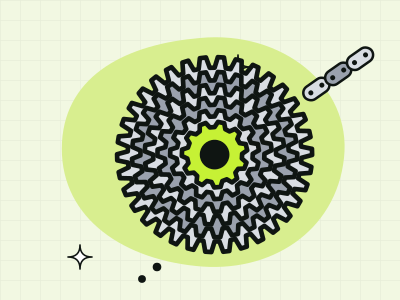
Picking chainrings and cogs means picking how far you travel with each pedal stroke. In a 50×11 you cover more than 30 ft (9 m) per turn of the cranks; in a 34×34, about 7 ft (2.1 m). Between those two extremes lies the difference between spinning your way to the top of a climb and grinding it out of the saddle at 50 rpm.
These guides explain gear ratios without the jargon: what the numbers on an 11-34 cassette or 50/34 chainrings mean, how to go from teeth to gear inches, distance per pedal stroke and miles per hour, and why cadence matters as much as strength. We compare 1x (one chainring) and 2x (two chainrings) drivetrains by the jumps between gears, total range and maintenance, so you know which one suits your rides.
The last guide answers the question we get most: what gearing you need to climb, based on the grade, your weight and your watts, with a cadence chart you can compare against your own bike.
Every number comes from the gear ratio calculator, which you can open with your own drivetrain. If you change your cassette, the chain length calculator tells you how many links you need, and the climb time calculator how long a specific climb would take you.
Guides on this topic
Bike Gear Ratios Explained: Chainring, Cog, Wheel and Cadence
A gear tells you how far the bike travels per pedal stroke. A 50x17 with 28 mm tires is 78.3 gear inches, or 6.25 m per pedal stroke, and at 90 rpm you're doing 21 mph (33.7 km/h).
1x vs 2x Drivetrain: Gear Range, Jumps and Weight Compared
With the same low gear (25 gear inches), a 48/31 double with an 11-34 cassette jumps 10.8% on average between gears and a 40-tooth 1x with a 10-44, 14.5%. The 2x is finer; the 1x is simpler.
What Gear Ratio You Need for Climbing, Based on Your Weight and Watts
A 165 lb rider on a 19 lb bike at 200 W climbs an 8% grade at 6.2 mph: in a 34x28 that's 64 rpm and in a 34x34, 78 rpm. To stay at 75 rpm or above you need about 27.6 gear inches (2.2 m of development).
How to Adjust a Rear Derailleur: Limit Screws, Cable Tension and Hanger
First make sure the hanger is straight; then set the high limit (H), the cable tension with the barrel adjuster, the low limit (L) and the B-tension gap. If the derailleur skips or rattles, it is almost always the cable or the hanger.
How to Change a Bike Cassette: Tools, Lockring Torque and Freehub Bodies
You need a 12-spline lockring tool, a chain whip and a big wrench. Tighten the lockring to 30-50 N·m on Shimano cassettes and about 40 N·m on SRAM. Before you buy, check your wheel's freehub body: HG, XD, XDR and Micro Spline are not interchangeable.
Shimano Road and Gravel Groupsets: Claris to Dura-Ace Compared
From entry level up: Claris (8-speed), Sora (9), Tiagra (10, and 11 from 2026), 105 (12, mechanical or Di2), then Ultegra and Dura-Ace (12, Di2 only). GRX is the gravel line. For most riders 105 is the sweet spot; Ultegra and Dura-Ace mostly save weight.
SRAM Groupsets Explained: Apex, Rival, Force, RED and Eagle Transmission
For road and gravel, from entry level up: Apex (1×12 only), Rival, Force and RED (2×12 or 1×13 XPLR), nearly all wireless AXS. SRAM puts RED AXS at 2,496 g (5.5 lb) and Rival AXS at 2,993 g (6.6 lb). On mountain bikes it's Eagle Transmission, which mounts straight to the frame with no limit screws.
Mechanical vs. Electronic Shifting (Di2, AXS): Which Is Worth It and for Whom
Electronic shifting is identical every time, never goes out of adjustment from cable stretch and can be customized; mechanical is cheaper, can be fixed anywhere and doesn't rely on a battery. Weight is a wash: SRAM lists 2,872 g for mechanical Apex XPLR and 2,890 g for AXS.
Save your bike once, use it everywhere
In My Bike you enter your measurements, wheels and drivetrain. From there we give you your tire pressure, saddle height, gearing and chain length, plus a shop sheet you can print.